
A physiotherapist explains why so many French people wake up with stiff knees, hips, or lower back… and it’s not always age.
 By Veral Editorial Team | Updated on June 26, 2026

The detail many side sleepers underestimate
If you sometimes wake up in the middle of the night with discomfort in your hips, knees, or lower back, you may have already blamed your age, your mattress, or a bad night's sleep.
But in many cases, the problem is much simpler: your body remains for several hours in a position that lacks support.
When you sleep on your side, the top leg can fall forward, the knees touch, the pelvis rotates slightly, and the lower back compensates without you realizing it.
The result: you move around, search for a better position, wake up, and then start the day already feeling stiff.
The problem is not always the pain itself. It is often the position in which your body remains for hours.

Illustration: when the body lacks support, it compensates during rest.
The human body likes stability. During rest, any area that lacks support can force another area to compensate.
Knees that touch create direct pressure. Hips can lose their natural alignment. The lower back can remain tense throughout the night.
This is exactly why properly placed support can make a real difference in how comfortable you feel.

Support placed in the right spot helps the body maintain a more stable position.
The most frustrating thing is that many people are already trying to “jury-rig” a solution: an ordinary cushion between their legs, a pillow under their knees, or a rolled-up blanket behind their back.
In the moment, this may help a little. But as soon as you move, the cushion slips, flattens, or no longer supports the right area.
And if your support changes every ten minutes, your body starts searching for a comfortable position all over again.
That is when the difference between improvised support and a proper ergonomic cushion becomes clear.
5 signs your body may lack support during rest
And why ignoring them can make your nights even more uncomfortable.
1. Your knees touch when you sleep on your side
You lie on your side, but your knees end up pressing against each other. This pressure can become uncomfortable over time, especially if you stay in the same position for long periods.
2. Your hips are stiff when you wake up
If the top leg falls forward, the pelvis can rotate slightly. Even if the movement seems minimal, it can create a feeling of stiffness upon waking.
3. Your lower back pulls starting in the morning
When the hips and knees are not properly supported, the lower back can compensate all night long. As a result, you may wake up feeling tense, even after several hours of sleep.
4. You constantly change positions
You toss and turn, readjust a pillow, try the other side… but comfort never lasts long. It’s not always a matter of willpower: your body is simply looking for better support.
5. Your legs feel heavy at the end of the day
After several hours standing or sitting, slightly elevating your legs can make rest periods more comfortable. A stable and comfortable support is essential.
Why what you’ve tried doesn’t really stick
It’s not necessarily because you made the wrong choice. It’s often because makeshift solutions aren’t designed to stay in place for several hours.
A regular pillow can work in a pinch. But it wasn’t designed to provide precise support between the knees, under the legs, or behind the back.
That’s why many people feel like they’ve “tried everything”… without ever achieving lasting comfort.

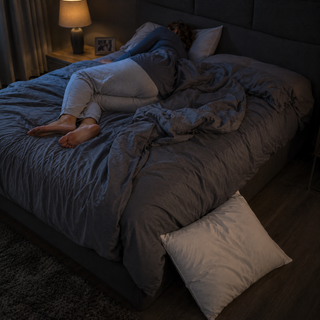
Ordinary pillows can slip, flatten, or shift during the night.
Why makeshift support often fails:
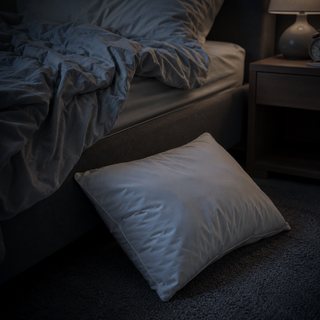
It slides as soon as you move
A regular pillow is not secured. As soon as you change sides, it can fall, shift, or end up too low.
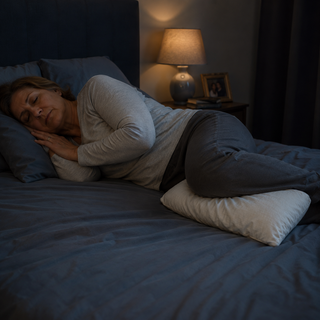
It is crushed by body weight
Many pillows become too flat after a few minutes. The support disappears, and the pressure returns.
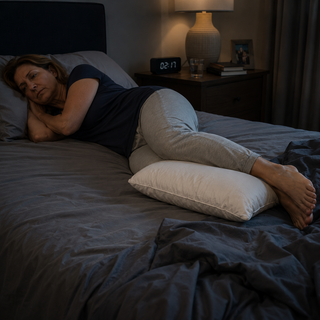
It supports the wrong area
A standard pillow is not designed to support the knees, legs, or lower back. It can provide support that is too wide, too soft, or poorly positioned.
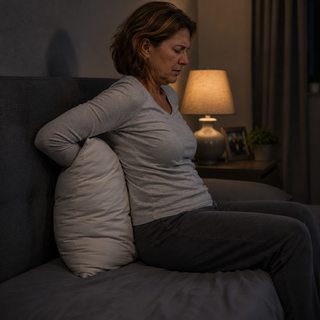
It does not adapt to multiple uses
Between the knees, under the legs, behind the back… every position requires different support. A standard pillow has its limits.
It disrupts your sleep
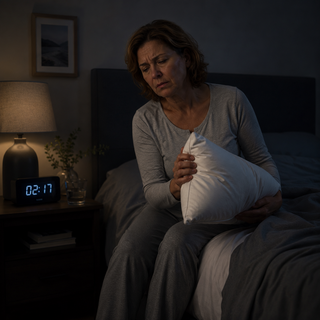
When you have to readjust it several times, your rest becomes less natural. The support should help you relax, not force you to wake up.
It does not address the main objection
The real question isn’t just “is it soft?”. The real question is: does the support stay stable where your body needs it?
Simple conclusion?
If your support slips, bottoms out, or shifts, your body eventually compensates. To regain a more comfortable position, you need targeted, stable support that is easy to position.
What happens when the body compensates all night
A bad position isn’t always felt immediately. But night after night, it can make waking up much more uncomfortable.
Your knees touch. Your pelvis twists slightly. Your lower back remains tense. Your legs search for support. You shift positions, then do it again.
This cycle alone can disrupt your rest and leave you feeling less refreshed than before.

Without targeted support, the body compensates. With Soutinéa™, the position becomes more stable.

When the support is more stable, resting can become much more pleasant.
The Soutinéa™ method: targeted support where your body needs it
Soutinéa™ was designed to address a simple problem: an ordinary pillow can be soft, but it is not always stable, nor is it always suitable for areas that really need support.
With its ergonomic shape, memory foam, and support strap, Soutinéa™ helps provide more targeted support during your moments of rest.
1. Between the knees, to help reduce knee-to-knee pressure when sleeping on your side.
2. Under the legs, to elevate the ankles or legs after a long day.
3. Behind the lower back, to add comfortable support on the couch or in bed.
4. Under the neck, for targeted support during moments of relaxation.

Soutinéa™ — 4-in-1 ergonomic support cushion.
Why Soutinéa™ is different
Soutinéa™ is not intended to replace your mattress or force you into a particular position. It simply supports areas that lack proper backing, providing more stable support than an improvised cushion.
It is lightweight, easy to position, pleasant to the touch, and designed to blend naturally into your moments of rest.
Adjustable elastic band to stay better in place
Comfortable memory foam
4-in-1 support: knees, back, legs, neck
Removable and washable cover for everyday use
What you may feel after a few nights
From the very first uses: you’ll find it easier to place the cushion according to your position.
After a few nights: the support feels more natural, especially between the knees or under the legs.
After one to two weeks: many users say they automatically incorporate it into their rest routine.
Every day: Soutinéa™ can accompany you to bed, on the couch, or during your moments of relaxation.
Not all support cushions are created equal
Many pillows look similar in photos. Yet, in use, the differences are felt very quickly: support, shape, stability, maintenance, comfort.
The real question isn’t just “is it soft?”. The real question is: does the support stay in the right place when you move?
| Characteristic | Soutinéa™ | Improvised support |
|---|---|---|
| Adjustable strap | ✅ | ❌ |
| Memory foam | ✅ | ❌ |
| 4-in-1 support | ✅ | ❌ |
| Removable and washable cover | ✅ | ❌ |
| Stays in place better | ✅ | ❌ |
| Easy daily use | ✅ | ⚠️ |
What users notice most


What happens when you click
You have arrived on the official Soutinéa™ page. You can choose your pack, check the current offer and order directly from the Veral store.
For everyday use, many customers choose two cushions: one for the bedroom, one for the living room. But a single Soutinéa™ is already enough to discover targeted support.
For your comfort,
The Veral Team
Targeted support for the knees, back, legs, and neck
Adjustable support strap
Removable and washable cover
90-night home trial
If your nights are often interrupted by an awkward position, if your knees touch, if your lower back lacks support, or if your legs need more comfortable support, Soutinéa™ can become a simple addition to your nightly routine.
Check availability while the offer is still active.
Legal Notices · Privacy ·